Thick fog surrounded our RV at 3685 ft, the top of Eagle Summit. Persistent rain hit the windshield and slithered down with the consistency of water transitioning to snow. Hundreds of hunters in every type of shelter camped exposed on barren ridge lines below the summit. An occasional tent was staked in the roadside ditch, protected from the wind, in an effort to avoid being uplifted and blown away in Mary Poppins fashion. A brightly colored beach umbrella lay crumpled against a side hill, deposited far from any campsite.
Our visit to North Pole, near Fairbanks Alaska, was to include a few days of camping beside the Chena River and a day spent soaking in Chena Hot Springs. This plan abruptly changed following a drive northeast of Fairbanks to Ski Land. I was interested in seeing this small ski area described by our daughter, Carlisle, as a step back in time and reminiscent of Vermont’s ski area history.
Ski Land sits atop Cleary Pass, one of three passes along the 161 mile Steese Highway stretching from Fairbanks to Circle. It’s here that the northernmost chair lift in North America is found. We found it interesting that ski customer parking, ski rental and lodge are at the top of the lift and not at the base. If the lift were to break down, it’d be quite a hike back to the car. From the mountain top we were given a panoramic view of the White Mountains, the excavation surrounding Fort Knox a huge open pit gold mine and places far beyond.
Chatanika Lodge is found about 15 miles up the highway beyond Ski Land. We took a look inside and if we hadn’t just eaten, the cheese steak sandwiches and dredge burgers looked amazing. A middle aged man was busy talking to Shirley, the owner. My ears perked up when he asked if many Johnny Cash fans visited. She looked puzzled. He went on to explain that he was visiting the 92 places mentioned in Cash’s song, “I’ve Been Everywhere”. Shirley maintained a puzzled look as she asked if he was sure it was Chatanika and not Chattanooga.
Christmas in August!
The fellow replied with confidence that it was indeed Chatanika and would she like him to recite for memory all the towns mentioned? To this, Shirley, apparently still confused, politely answered, “no” and handed him his burger. A check with Google confirmed it was indeed Chatanika. We later learned that this man worked for the airlines which facilitated his worldwide travel. He was accompanied by his wife and son who both seemed equally interested in his quest. His son smiled between bites of his dredge burger as his dad told Shirley that Chatanika was one of the final six remaining towns left of the 92.
Both Shirley and I were momentarily distracted by a pretty, blond haired woman picking up a take out order, 20 dredge burgers for Knox Mine. The bill was $220 and she had forgotten her credit card. Shirley's husband was quick to say, "No worries, stop back later with your card". Was it her youthful good looks or are the folks of Chatanika as trusting as a Johnny Cash lyric?
As we drove further away from civilization, we weren’t surprised to find the shoulders of the highway crowded with hunters, atvs and trailers. Caribou hunting had begun. The road transitioned from pavement to well maintained dirt and the RV melded into the hunting scenery, except for our VT license plates.
Snuggled in for the night.
The treeless landscape allowed hunters to glass for migrating caribou, seeing for miles in all directions. The road took us down into creek bottoms still being mined and up to high summits shrouded in fog. Groups of hunters seemed to have favored locations, either snug beside a clear brook or buffeted by wind up high.
We weren’t here to hunt, but to see two towns at the end of the Steese Highway, Central at mile 127.7 and Circle at 161.3, only 50 miles south of the Arctic Circle. These towns had meaning to me as I follow the Yukon Quest, a 1000 mile dogsled race between Whitehorse, Yukon and Fairbanks AK. Some of the most challenging terrain of the race lies in the area we’re exploring.
Old mining equipment on display outside the Circle District Historical Society Museum, located in Central. Unfortunately, the museum wasn’t open. Central was once known as Central House and is on Crooked Creek, within one of the oldest and richest mining districts in Alaska.
Central has no school and a population of 86 hardy souls. The Milepost describes Central as being subarctic with, ”winters that are long and harsh and summers warm and short”. It appeared, during this visit, that summer was nearing an end. From Central Corner, seen in the video above, we headed down Circle Hot Springs Road, also in Central. I often felt we were talking in circles as many things in Central referred to Circle. We were surprised how well maintained the roads were in towns of small population and so far from Fairbanks. Power poles dotted the roadside here while much of our town of Talkeetna has no power. We knew Circle Hot Springs had been closed for years but hoped for a closer look than we obtained.
It appeared as though some hunters had traveled by airplane.
Circle Hot Springs appeared empty and eerie on this cloudy day. It would have been fun to have seen the springs, but numerous no trespassing signs indicated it wouldn't be wise.
We continued on from Central driving through low wet areas and high hills. We navigated around numerous hairpin turns before finally arriving in Circle, on the bank of the mighty Yukon River.
Circle was once the largest gold mining town on the Yukon until the Klondike rush of 1898 and the rapid growth of Dawson City. Now, Circle has a population of 108 and a school of 20 plus students, Pre-k through grade 12. Circle has survived both floods and wildfire.
Lunch and 💤 beside the Yukon. We LOVE our house on wheels!
Rasmussen House, built in 1909 seen through raindrops on our windshield.
As is often the case, our return to Fairbanks seemed to present entirely different scenery despite covering the same ground, just in reverse. Pull offs that were crowded before were now packed with hunters leaving no room for us to squeeze in. We felt lucky to finally find a spot and be the only ones there. However, it wasn’t long before we had numerous neighbors. I really enjoyed watching young sons and daughters included in their parents' hunt. Dressed in camouflage, they bopped around the pick up trucks, fussed with hunting gear and sat eating a meal cooked on a camp stove, under a tarp. Everyone smiling despite the drizzle. Whether the hunt was successful or not, I could see memories being made. I felt equally as fortunate to be in our warm RV, cooking on my 3 burner stove, using my indoor toilet and crawling into my queen size bed.
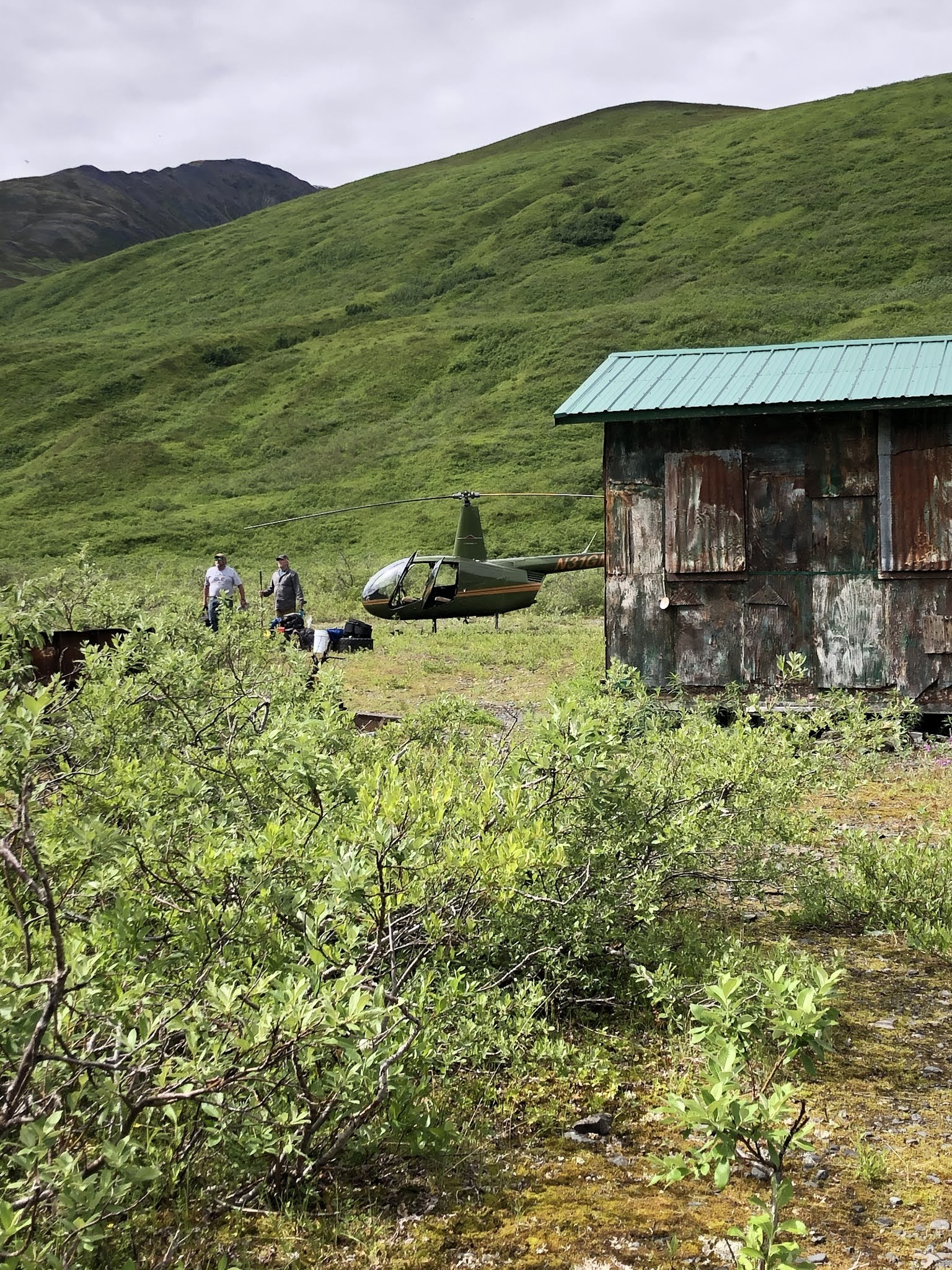
The fur on the Grizzly's neck gleamed golden in the sun, merging with the wet brown fur of its legs as it fished in the clear water. It paid no attention to our helicopter passing overhead, neither did the cow moose standing knee deep in a kettle pond, one of the many ponds dotting the valley landscape. Beneath us, the creek banks were lined by Alder and Willow and silt laden braids of the Susitna River flowed toward the sea. Brown islands of beetle killed spruce stood like silent sentinels in an otherwise green landscape.
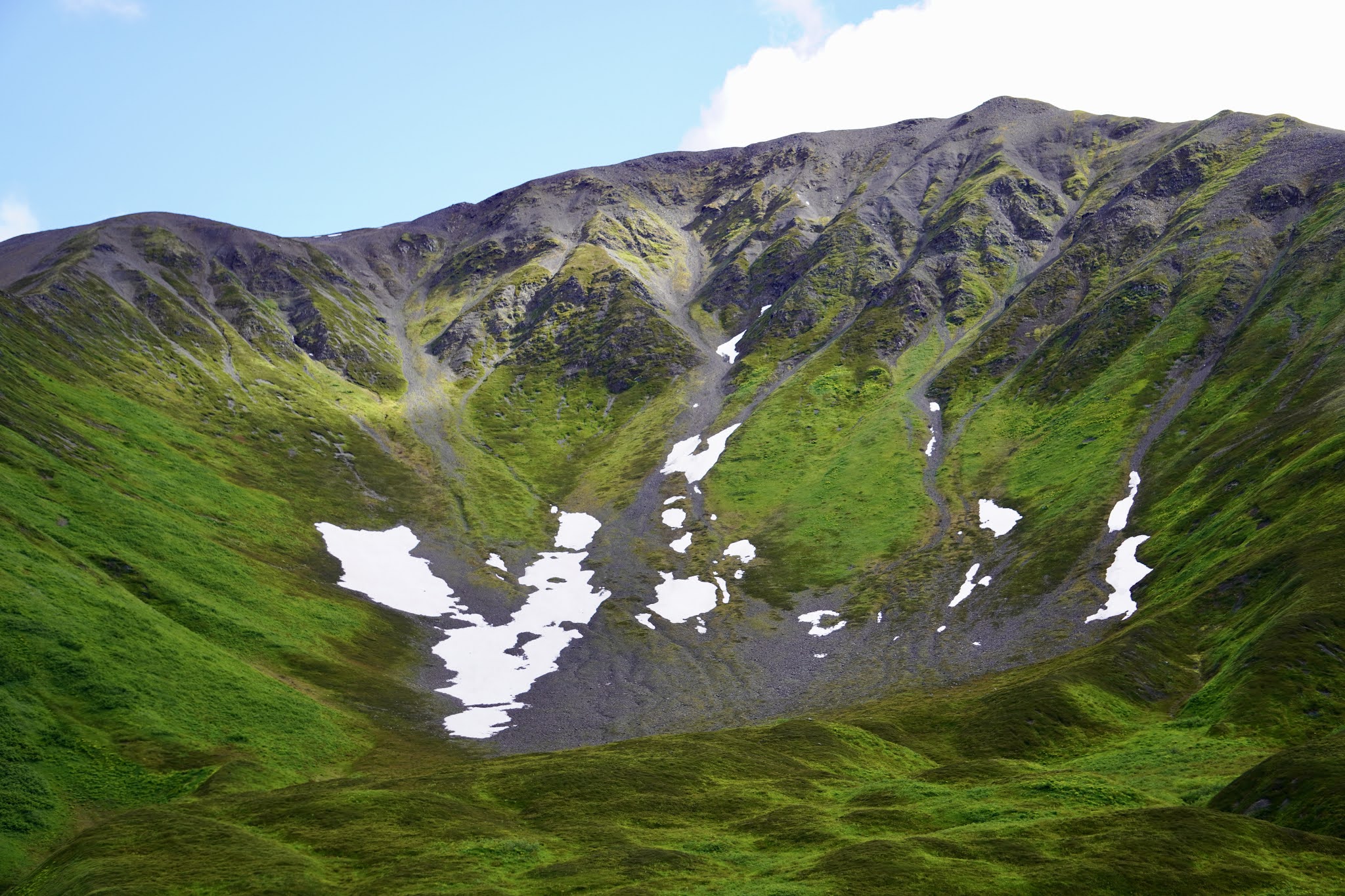
Our helicopter steadily gained altitude and the Kanikula Glacier came into view with its rock covered terminus and melting rivulets of ice water. In the past, I've seen moose standing on the glacier's tail as if on a foreign planet, but smartly placed out of the reach of hunters. We abruptly banked hard left sweeping into the steep sided Bear Creek valley.
These AK hills and streams are known to hold GOLD. So, in keeping with the 2021 summer Olympics and honoring our golden years (Bucky just turned 75), we became gold seekers.
Bucky began our search by walking up Bear Creek toward its source in the hills; however, we never made it up very high. The Willow and Alder grabbed at our ankles and unseen raised roots sabotoged each step. The steep slope created a fast running current with water too deep for our knee boots. We had no choice but to head back downstream. I had hoped the abundance of Willow would yield a Willow Rose, but none appeared.
Here Bucky was able to shovel desirable river dirt into his spackle bucket, while I enjoyed the wild flowers and birds that surrounded us. He eliminated large rock and worked through his dirt leaving what seemed promising to be sifted further at camp. Mosquitoes hummed and occasionally hit their target but weren’t a big problem. After taking dirt from three different sites, we headed back to camp, looking forward to a Mountain House dehydrated meal which taste surprisingly good at times like this.
Bucky sat on the creek bank sifting dirt and sand. Finally, the dirt was reduced to fine grains of sand that could be shifted easily back and forth over the ridges of his gold pan. Occasionally a flash of gold could be seen. It resembled the glitter bought in tubes for a child's art creation, minute specks that appeared, disappeared and then reappeared. These golden pin points would slide beneath larger grains of sand making them impossible to retrieve. Eventually, the pan was washed clean and the process repeated with the remaining dirt.
It didn't dawn on me until I began writing. how aptly named the Golden Crowned Sparrow is for this post. Their melodious song could be heard from a great distance while the flow of water over the rocks of Bear Creek provided a steady background cadence. Remote areas such as this, where nature is so close at hand, where birds do not fly in fright and where rodents become pets, generate feelings of relaxation, hopefulness and rejuvenate one's spirit.
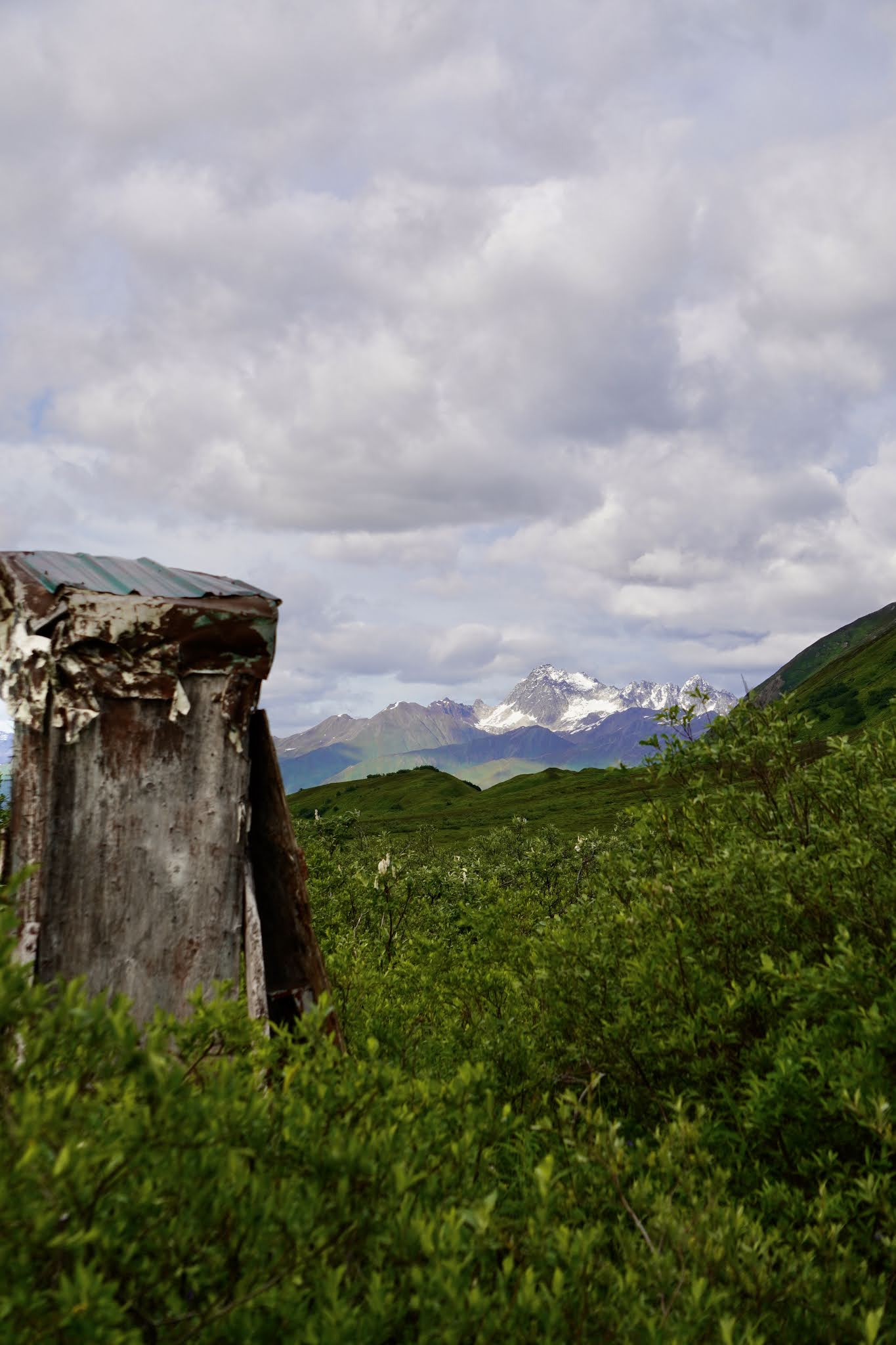
Our evenings were spent watching shadows form on the hills and clouds come and go across the high peaks.
This is one of the loveliest spots we have seen in Alaska and it's only a half hour flight from our cabin in Talkeetna. (see in archives January 22, 2019 for our first visit)
Around 7:30 one evening, we watched a large black bear move laterally across the terrain. The black fur was easily seen against a green background . Anything seen as large with the naked eye in this big country, is BIG. We watched as the bear dipped into ravines disappearing from view only to reappear yards away. The bear crossed snow fields and at one point ran quickly forward as if startled or chasing something.We talked about what might have prompted this. I found myself imagining this bear’s thoughts and what life would be like as a bear in Bear Creek Valley. I had heard the story behind Carlisle’s large bear hide hanging in our cabin. Up here, man is the sole predator of these animals. I include this image so you see the bear as we did.
We saw moose both from the helicopter and while sitting at camp. We watched a cow stride effortlessly through brush, its head high above the branches and within minutes it disappeared into the safety of Denali National Park. I thought of our walk the previous day, navigating tangles and the time it took to go a short distance. Taking strides with long legs that defied the entanglement of Alder and Willow, the moose had no difficulty covering the steep terrain. A large bull moose, accompanied by two cows, innocently displayed a massive set of antlers as our helicopter flew by. He would be smart to be less obvious next month when hunting season arrives.
Can you find the moose in this picture?
I’d like my next image to be of a large gold nugget, a chunk of yellow metal that through the ages has been sought after, fought over and has adorned the bodies of the wealthy. I would have mounted mine in a ring or necklace, but that’s not possible. We had low expectations of finding gold so there was zero disappointment, but instead, a reminder of our many riches. Gold is found in many forms and is available for us all to mine.
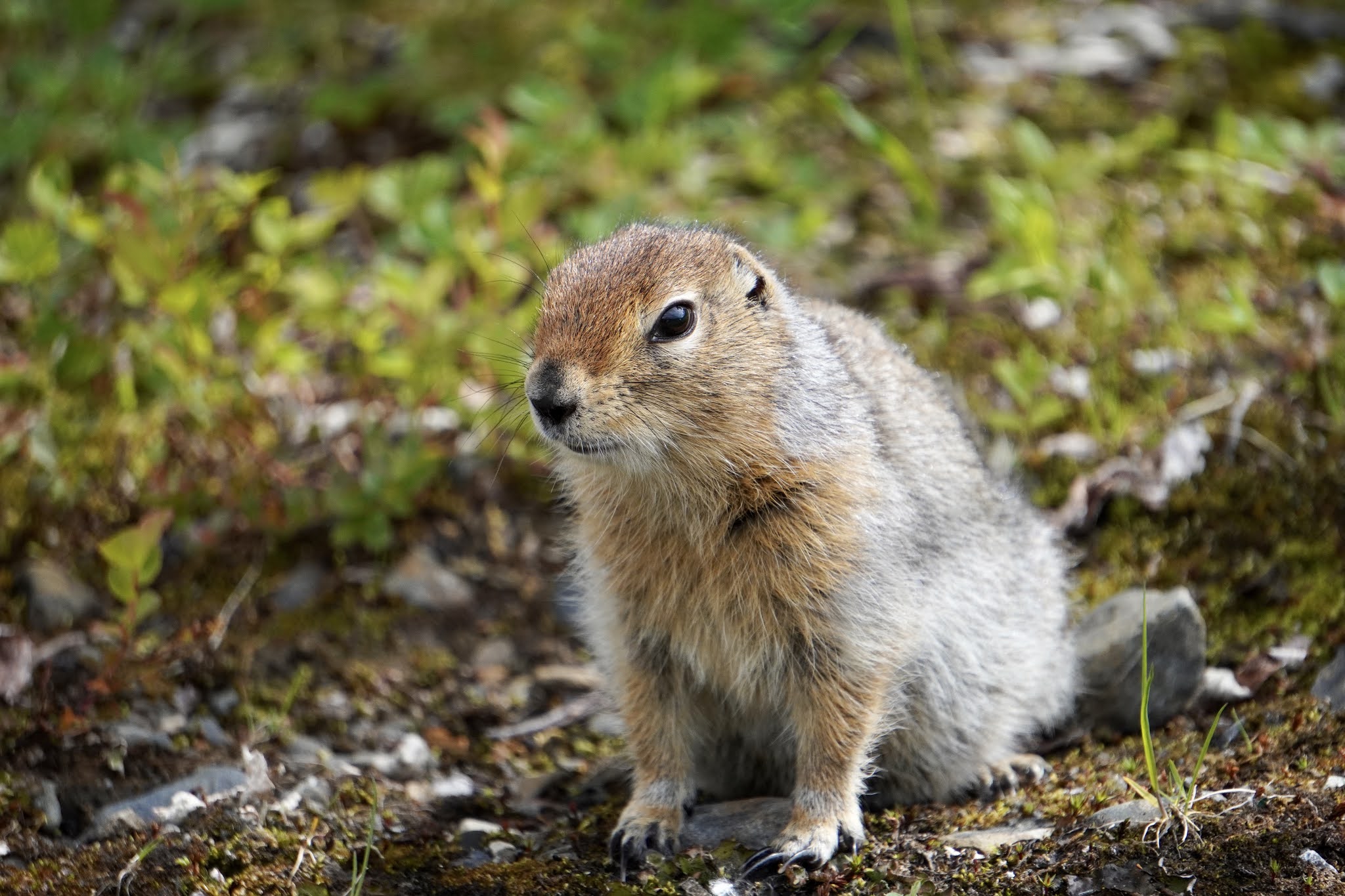
Our buddy. He liked my dish washing bowl. His perfectly erect posture, balanced on his tail, is a story in itself. We never named him and just when we thought he was a solitary ground squirrel, we started seeing him in multiple places!
“Hiding in the glorious wildness like unmined gold”. John Muir
Our return trip to Talkeetna was as interesting as our arrival. We passed some large gold mines in Petersville that had been in family possession for generations. The digging at these mines was not by hand and shovel, but by large equipment. However, it’s the same process, large rocks are discarded, water is used to separate material until it becomes finer and finer with gold always sinking to the bottom.
I’ve included a few pictures that I liked but couldn’t fit into the text.
We were super excited to reunite with Carlisle, our youngest daughter, having not seen her for 6 months. She recently moved from Alaska to Ely, Minnesota. Transitioning to a new town, new job and strangers is never easy, but in true Minnesotan fashion, she was met with open arms. By association, we also felt the love. Hospitality must be genetic here. Unusually hot temperatures greeted us, but this quickly changed with gentle rain piercing the lake's surface and hydrating the brown grass.
Carlisle is living about 30 minutes drive from her job in Ely, in the small town of Babbitt. Babbitt is located on the Mesabi Iron Mining Range and is rich in history as well as recreation. Trails for snowmachines and atvs abound and one of the many lakes of the area, Birch Lake, lies just outside of town.
Ely has strong appeal to outdoor enthusiasts and summer vacationers making rentals nearly impossible to find. Word of mouth remains the best way to secure a place to live which was the case with Lisle. The many outfitters and boat rental businesses in Ely prepare paddlers for accessing the Boundary Waters Canoe Area Wilderness, over 1,000,000 acres of forest and water. The BWCA is bordered by 3,900,000 acres of Superior National Forest and Ontario's provincial park. This forested, aquatic playground is just a two hour drive from Duluth and twice that from Minneapolis/St Paul. www.fs.usda.gov
Our stay began with a visit to Carlisle’s workplace, Ely's USFS Seaplane base, the only float plane base operated by the USFS in the US. The airplanes based here are de Havilland Beavers built in the 1950’s. These workhorse airplanes are equipped for fire detection, scooping water for fire fighting, transporting firefighters, wilderness search and rescue, aerial tree seeding, fish stocking and wildlife surveying.
Lisle gave us a tour of the meticulously maintained hangar and airplanes.
We were soon introduced to Gracie, a USFS pilot based out of Colorado, who charmed us with her wisdom and riotous sense of humor. During the following days we became family. While Lisle worked, Gracie gave us a tour of the Ely Tanker Base at the Ely Airport.
It's here that the airplanes, helicopters, pilots and the firefighters so essential in extinguishing wilderness blazes, wait to be deployed. Much like a fire station sitting on a runway. Lightning strikes and a smoldering campfire were responsible for some recent activity. The USFS works alongside the Tanker Base conducting routine patrols and having the ability to extinguish small fires before they expand, and alerting the heavier aircraft if needed.
Fire Boss AT-802
Shannon, explained the use of his airplane in firefighting, think crop dusting with water instead of pesticide. It involves scooping 800 gallons of water in approximately 12 seconds at high speed while delicately skimming the water’s surface, requiring about a mile of lake. It's critical to maintain the correct speed when incurring drag while scooping, then lifting off before the lake ends and treeline is met. Despite sitting on floats, these amphibian airplanes are not designed to rest on the water. A synchronous ballet of lever pulls, button pushes, yolk and pedal work performed in a cockpit similar to that of a fighter jet, Doesn't everyone want to be a Fire Boss pilot?
Pilot of the hour!!
We also were able to see Gracie's Kodiak which she had flown to Ely from Colorado. This luxurious machine is used by USFS employees focused on forest health protection.....beetles, storm damage
The Quest manufactured Kodiak has all the bells and whistles including bear claw pedals!
Who wouldn't want to be a Kodiak pilot?
When at the Tanker Base we met Blake, who not only dispatches and monitors aircraft, but is also an Iditarod musher. I was thrilled when he invited us to visit his kennel of racing Siberian Huskies located about an hour's drive from Ely in Finland, MN. www.racingsiberians.com
The road to Finland wound like a slithering snake around lakes and across rivers. I expected to see a moose at any minute standing in water beside the road. Deer and moose live here as well as wolves. Knowing that mushers like Blake and his wife Jennifer make this their home, made it feel like Alaska. Swarms of mosquitoes completed the picture!
I was particularly attracted to Frosty who reminded me so much of our dog Fisher. Jennifer said she was a great team leader. I tried to pet her, but although she and all the dogs were incredibly friendly, she never let me touch her, preferring to watch me from her porch. Jennifer gave us a tour explaining how they care for 60 plus dogs. We were excited to meet their new puppies!
A portion of the property is fenced off allowing the dogs to be released to run and play while secure behind fence. I laughed when Jennifer told of Billie, mother of the puppies, jumping the fence and killing a chicken. Unpleasant memories of several domestic animals killed by Fisher quickly surfaced. On this day, not long after the puppies were returned to their doghouse, Billie made another dash for freedom. Vigilance, second nature in all Siberian owners, allowed Jennifer to see her outside the fence and quickly retrieve her. Her watchful eye and quick reaction to the escape reminded me of myself not so many years ago.
Siberians can NEVER be trusted!
Our four days in Ely were quickly filled. While Carlisle was at work we tidied the RV, did laundry, shopped for food and visited spots like the International Wolf Center and the North American Bear Center. Bucky and I don't usually gravitate toward attractions, but these peaked our interest and Lisle was able to join us on her day off. The habitat of both the wolves and bears, although limited acreage, appeared very natural. Both facilities had wonderful displays, films and taxidermy. There was a bit of a zoo like feeling with the bears, but I'm not sure bears could be housed differently.
Of course, the wolf at the back, Greyson, much like Frosty the Siberian, reminded me of Fisher. It's easy to see a genetic link both in appearance and behavior between wolves and Siberians.
Saying goodbye to Carlisle was sad. Spending the summer in Alaska without her energy and laughter will be different. However, Ely is in the gps for the return trip.