Tuesday, July 23, 2013

Denali

Denali National Park is considered a wilderness park as only one road exists within the park.  This is a private road to Kantishna.  Visitors to the park must use the transportation provided, green school buses, if they wish to see the Park's interior.  Of course, foot travel is always allowed.  The round trip bus ride to Kantishna takes 12 hours!  We were scheduled for the first bus of the day leaving the Wilderness Access Center at 7:45.  With lunches and drinks packed, we braced for the day ahead.

The morning sky treated us to a mosaic of colors.  Our anticipated 92 mile trip would allow us to see only a fraction of the Park's 6 million acres.  And, what everyone really hoped to see was the magnificent mountain herself.  The foggy morning with breaks of sun made us hopeful. 


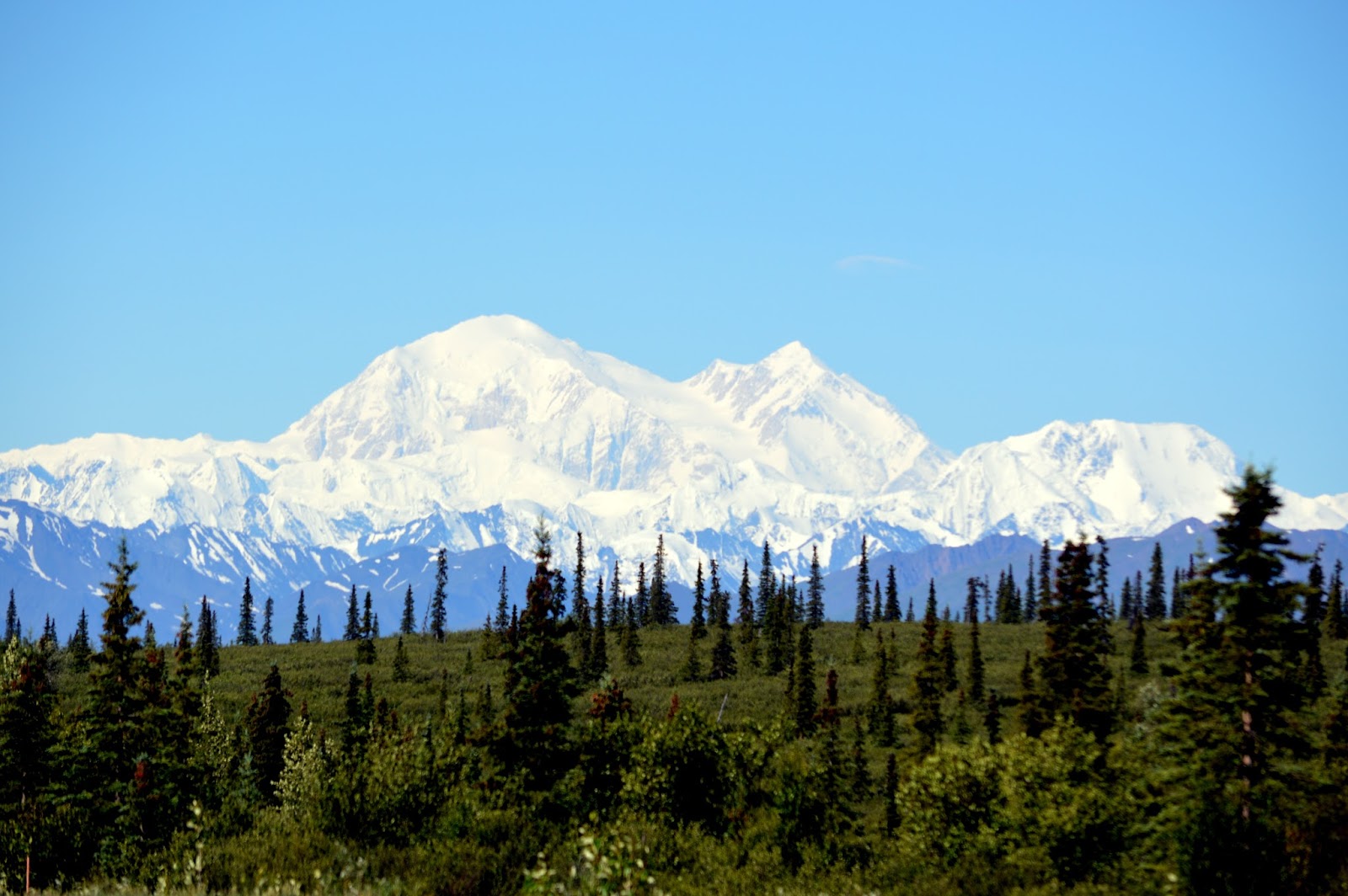
We were provided with a peek of Denali through the clouds.  There was hope the clouds would lift, but this never happened.  The mountain is visable during the summer months, 30-40 pecent of the time, whatever that figures out to be!  The Athabascan Indians of the region called the mountain Denali, the high one, but in 1896 the mountain was named for William McKinley.  However, in 1980, the mountain's name went back to Denali.  By either name, she is magnificent.  All visitors to the Park are anxious to see Denali but also the many animals that make the park their home.  We were treated to the ones that follow.


Several of the Park's blond grizzlies walked near our long green "blind" as our driver Kim referred to our bus.  We were sure to be quiet and respectful of those taking videos and to raise and lower our windows at the appropriate times for fear of being admonished.  After all, we had become a captive community!


It was at mile 66, the Eielson Visitor Center, when Bill, Judy, Bucky and I decided that we would leave our newly acquired "community" and stretch our legs on a tundra hike.  Dry tundra covers the slopes above the tree line at 3,500 feet.  I was happy that Judy shared my interest in the many tundra flowers that lined our path.  It's my hope to someday learn their names and organize my pictures in a way to allow easy access when my tired mind forgets.


                                                                         Arctic Poppy


                               Arctic ground squirrels were amusing companions on our hike.

Not the summit of Denali, but awesome none the less.
 

What better way to end the day than by a warm campfire.  Keep in mind that this is taking place at close to 11pm with plenty of daylight.  The lack of rain and warming temperatures made tomorrow seem like the perfect day for Denali to appear.


And, as if by magic, there she was.  We were offered numerous opportunities to photograph her as we made our way back to Talkeetna, where we feel she looks the most beautiful.

Wednesday, July 17, 2013

B Really is for Bear


Our search for Coastal Brown Bear began with a early morning flight out of Homer, Alaska on Homer Air.  We arrived at their hanger at the appointed time, 7:30 am.  The weather continued to be a mixture of rain, low clouds and periodically some clear sky.  A mixture that had us wondering if our bear viewing would even take place.  However, there seemed to be no doubt in the mind of our pilot, Tyler, that we would be leaving as planned.  It was great to have the airplane to ourselves and the hour flight over Cook Inlet to Chinitna Bay, in Lake Clark Nat'l Park, was smooth, providing us with some views of Mount Iliamna with her head in the clouds.  A beach landing in a small airplane is always a thrill!  From the air, we could see bears clamming on the beach while others fed on lush green grass.  There are no rangers or platforms here from which to view the bears like we had experienced at Brooks Falls in Katmai National Park, just us and Tyler wandering among the bears.  There are some Park postings that explain bear etiquette, something we wanted to follow, particularly dining ettiquette.  I'll let my pictures speak for themselves as no words can do justice.
                                                                 Wet, but happy!


                                          Check out Bill's beard for a future post.


                                                                                   Bear hugs


                                                                      Who's scared of who?
                                                           Just resting!

B is for Bear part 2


We all slept soundly beneath the cross of the Lutheran Church, despite the fireworks at midnight over the small boat harbor.  We were excited to see what this race up Mt. Marathon was all about.  The rough dirt trail up the mountain was evident and told to be steep and in places unforgiving.  We remembered that in the 2012 race, an older runner was lost and never found!  As we sipped our steaming morning coffee, race participants were evident on the street.  It appeared as though some had slept in their cars.  Seward became lively as the start time for the youth race approached.
 
Getting an understanding of the course.
The town of Seward took on a festive air with great smells everywhere.  We took time to sample a few tasty treats and of course do some people watching.


Sorry to focus on Bill and Judy eating, as we all did our part.  I particularly enjoyed my spicy reindeer sausage.
First of the young runners.
 
A budding star.
 
 
Despite the rain and cool temperatures, not unusual for this seaside town, the crowd and the runners brought joy on this July 4th.  It certainly is a very special event.  I tried to capture some of this in pictures.  Surely a post of xtra tuff wearers will have to follow at a later time.


xtra tuffs 


Trying to locate runners on the trail.  We could see them start and finish, but in between was a challenge.  Just a few colorful dots on the side of the mountain.


The course


Monday, July 15, 2013

B is for bear

Nonresidents of Alaska make certain associations when thinking about this great state, cold, snow, polar bears, Eskimos, igloos, whales and fuel oil. Residents of Alaska make some of the same associations, cold, snow, and oil, but also snow machines, 4 wheelers, gold, moose, salmon and bears. Reference is often made to the gold of Alaska, be it the black gold of the Arctic or the yellow gold found throughout the state. But, our trip did not include gold panning or viewing the tankers being filled in Prince William Sound, instead we headed from Homer, Alaska by airplane to view Coastal Brown Bears at Chinitna Bay in Lake Clark National Park.  We were excited about seeing these huge bears, often much larger than the interior Grizzly. With milder temperatures near the ocean, these bears hibernate for a shorter period of time and have a year round food source allowing them to grow large.  A mature, Brown Bear can weigh as much as 1000 pounds. 
The city of Homer lies at the bottom of the Kenai Peninsula, a unique city loved by residents and nonresidents alike.  On July 2nd, we scooped up our friends, Bill and Judy, who had flown into Anchorage.  We then made our way south along the Turnagain Arm of Cook Inlet sheltered by the snow capped Chugach Mountains, our first destination being Seward, Alaska.  Many Alaskan roads are "in and out" roads.  Surprisingly, things often look different coming out than they did going in! The road to Seward is just that, 34 miles in and 34 miles out.  We debated as to if staying in Seward on the 4th of July was a good idea, knowing that it was the day of the Mt. Marathon Race and a possible party scene at the Exit Glacier.  But, on the other hand, what better place to celebrate!  So, down the Seward Highway we headed on July 3. The hike into Exit Glacier, in Kenai Fjords National Park gave us a chance to stretch our legs and view the cold, snow and ice that people associate with Alaska.  Exit Glacier is 2.4 miles long and descends some 3,500 feet.  As with most of the world's glaciers, the Exit Glacier is receding.  We noticed the viewing area had been moved further up the glacier since our last visit, an effort by the Park Service to give visitors a chance to be close before the Exit retreats forever, out of our reach.


      The glacial blue ice and dusty white snow surface of a glacier never ceases to amaze.


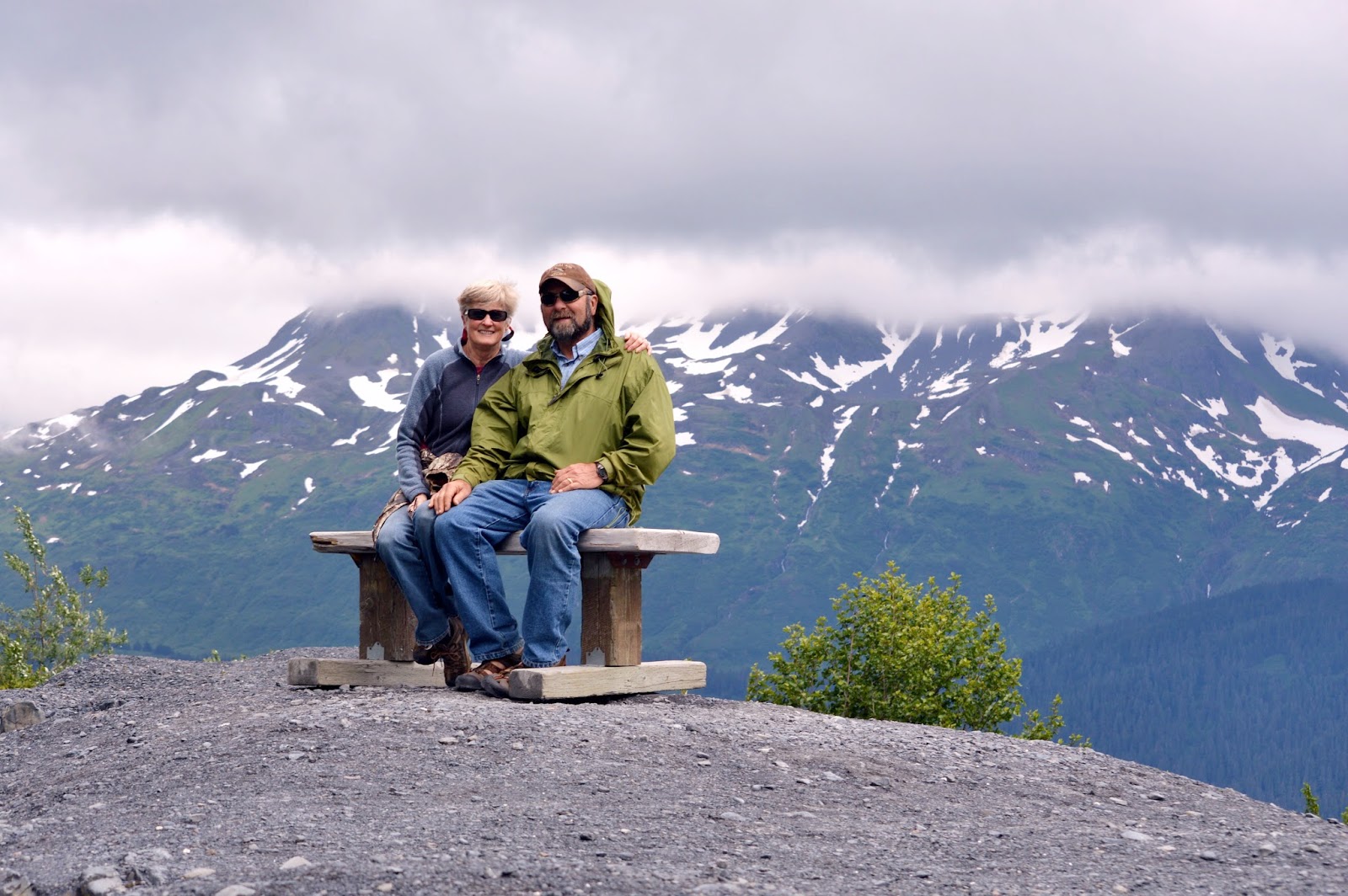
                       Some might say that we have our heads in the clouds.  If so, it feels great!

Trying to find camping in Seward for the night of July 3, on the eve of Mount Marathon was as difficult as we had anticipated.  However, the smell of reindeer sausage and kettle corn wafting from the tents downtown made it a priority to find a piece of pavement large enough to place the Hawk and to allow us to consume and explore.  After several failed attempts taking us further than we had ever been, beyond the city of Seward and wrapping around Resurrection Bay to Lowell Point, also the end of this dirt road.  Bill made one last futile, albeit brave, attempt to secure a parking place from a private homeowner, something untried by us in the past, but perhaps a new go to move in desperate times!  By the grace of God, or so it would seem, we were blessed upon our return to Seward to see a sign for parking in a small church yard.  $10 and we were saved, Praise the Lord!


                                                                    All dressed up for the 4th


 Checking out the top of Mt. Marathon, thinking, "ya, sure, hey...  really, I'm not kidding,  I think I COULD make it!" 

This year's Mt. Marathon Race roster showed 482 men,468 women, 435 boys and 130 girls with numbers.  All were prepared to run, scramble and claw their way to the top, into the fog and clouds before turning around to slide and slip back down, finishing on Seward's main street to the cheers of envious admirers like us!

(to be continued)

Monday, July 1, 2013

Number 5, What's in a number?

What makes number five so special to the Dorias?  Sutton was able to have it in 15, Burke was lucky enough to have it all four years, Levi started with it, then had 38 (8-3=5), then he got it back, Carlisle had it.  I think we actually have more 6s and 8s in our lives than we do fives.  We are a family of 6.  There are three 8s and two 6s in our phone number, two 6s in our street address, two 8s on my car license plate, so why 5?  I clapped my hands a few months ago when Levi and Joanna received their new VT phone number and it contained a 5. It had two 6s, but the fact that it had one 5, made it a good number to have.  And, their getting married in May, the fifth month of the year, that had to be lucky. And, their post office box is 75!  Five has always seemed more perfect, more desirable, even luckier despite being odd. 

This was our fifth drive to Alaska. Right around five thousand miles to our cabin in Talkeetna, there it is again, another 5.  For nine days, and over four thousand miles all had gone smoothly.  We are always prepared for a break down, but have never had so much as a flat.  Leaving the Kluane region and heading for the Alaska border, Bucky and I spoke of perhaps even getting to Talkeetna on the ninth day, a feat equal to last summer.  It would be very late, but we could do it, when suddenly,
"Did you hear that?"
I had heard it, something like metal hitting the pavement.  Definitely not a good sound.
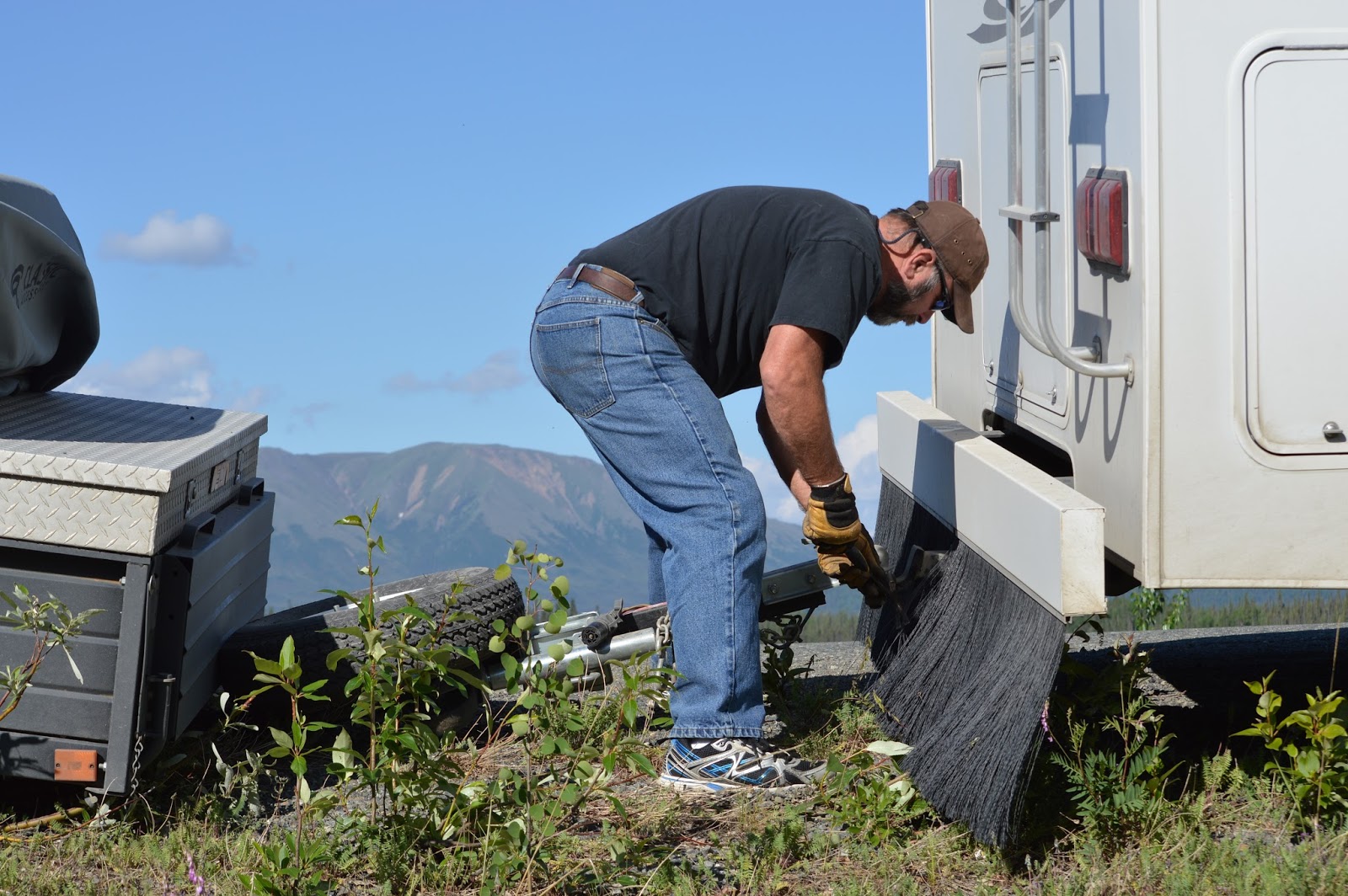
Bucky was quick to pull to the gravel shoulder and upon inspection there was no doubt as to where the sound originated.


We had no choice but to leave the trailer on the side of the road and drive the Hawk to the nearest town, Beaver Creek, YK, about 20 miles ahead.  Despite its small size, Beaver Creek has a Westmark Inn to accommodate tour buses as well as a nightclub called, Buckshot Annie's.  What was more helpful to us, was Far West Auto, a service center manned by Walter, 88 years young and his son-in-law, Carl, both with years of experience helping folks in need like us.

Walter was able to weld the tongue of the trailer, bringing it back to its original strength.  By stopping quickly, it had not broken all the way through.  Bucky and I felt incredibly fortunate that this happened when and where it did, We spent just a little over two hours at Far West and some of that time was while Walter went to lunch!
                                                        88 years young, with a story of his own

Bucky, Fisher and I were so happy to be back under way.  The border now lay less than 50 miles north.  It shouldn't be long now.  The further north we headed, the poorer the highway became.  The huge rollers caused by perma-frost were a bit better than last summer, but despite Bucky's keen eye, looking well ahead and at times taking the oncoming lane, there was just no avoiding the quick up and down of these huge frost heaves.  I was busy planning how to position Fisher and I for our picture in front of the Welcome to Alaska sign.

                                   Fisher is distracted by another dog coming for its photo op.

Finally, number 5, five trips across the US and a good portion of Canada and we're in Alaska.  Now, if we can be so lucky as to finish strong and most importantly safely. 


Alaska's roads are constantly under repair in the summer.  Pilot cars are used to guide large strings of traffic from one end of the construction to the other.  The wait for a pilot car can often be quite long, up to 30 minutes.  Bucky is forever shutting the RV down, getting out of his seat and heading back to the bathroom, leaving me to fret that I might have to actually get behind the wheel and pilot the Hawk behind the pilot car! 
It was after having passed through US customs, and not far from Tok, the first major town after entering AK, that Bucky again pulled quickly to the shoulder.
"What happened!", I asked.
"We blew a tire on the trailer."
By carefully monitoring the side mirrors, Bucky had seen the tire explode and the rubber fly.  Sitting on a very dangerous stretch of highway with huge trucks thundering by, was not the best place to change a roadside flat.  Within minutes, perhaps only 1 minute, a father and his son stopped to help.  With flashers on and the Dad flagging people to slow down, Bucky and the son were able to get the tire changed.  The son was on his way to Kodiak to the Air Force Base after having been stationed in Charleston, SC. I thought, quite a climate change!  Despite offering maple syrup, bottles of booze, and money, there was no way these two good Samaritans would take anything from us.  We were quickly able to pay it forward outside the small village of Christochina.  Here, we saw a young native woman with her thumb out walking the shoulder, her Jeep with a flat tire off to the side.  She hopped into the copilot seat and seemed to enjoy the attention that Fisher immediately gave her.  I felt badly that she wore black pants.  They were covered in white hair when she got out to leave.  We dropped her at her work, a brand new clinic, for the native residents of Christochina.  She told us that she drove each day from Nebesna to work at the clinic, a 45 mile trip one way.  It felt good to be able to help.

Despite the mishaps we experienced, I would like to think that 5 is still lucky.